
Greene County Supervision Types
Parole, probation, community control, and post-release control are not interchangeable labels. The judgment and agency record identify which one applies. Greene County Adult Probation manages community control ordered by the Common Pleas Court. A municipal court may supervise a misdemeanor sentence. By contrast, the Ohio Department of Rehabilitation and Correction Adult Parole Authority, or APA, supervises parole, post-release control, and certain people released from state prison. None of these systems is a county inmate roster.
A person may leave a prison or jail and still remain under legal supervision. That fact does not mean the release was invalid. It means physical custody ended while reporting duties or other terms continued. A direct community-control sentence may also place someone under Greene County probation without a prior ODRC prison stay.
| Supervision | Who imposes it | Where to verify |
|---|---|---|
| Parole | Ohio Parole Board under the applicable sentence | ODRC offender detail, hearing result, and official minutes |
| Post-release control | Applies under Ohio law to specified felony sentences | ODRC status and parole or release detail |
| Community control or probation | Common Pleas or a municipal court | Signed judgment, public docket, and the correct probation office |
- Parole
- Conditional release for a parole-eligible prison sentence after a board decision.
- Probation
- Court supervision in the community, commonly called community control in Ohio felony cases.
- Discharge
- The formal end of the relevant supervision term, not merely release from a facility.
- Absconder
- A person alleged to have stopped reporting or left supervision without authority.
Verify Greene County Supervision
Begin with the sentence source. A Greene County felony commitment that led to state prison belongs in the ODRC Offender Search. A local community-control sentence belongs in the Greene Common Pleas docket and Adult Probation system. Xenia or Fairborn Municipal Court may control a misdemeanor case. Searching the wrong system can make valid supervision look absent.
- Identify the court case and whether the person entered ODRC custody. Match the name with a case number or offender number when possible.
- For an ODRC case, search all statuses first. Open the matching detail, then review status, county of commitment, release detail, supervision dates, and any named APA office.
- Repeat with the APA Supervision status if needed. Do not use the Released filter alone because it can omit a person now shown under state supervision.
- For county probation, check Common Pleas CourtView for the signed sentence, community-control order, judicial-release entry, violation entry, or discharge.
- Contact the office shown in the record for appropriate confirmation. Ask about the public status, not protected case plans, risk reports, or treatment material.
The Greene County released-inmate search and records path helps establish the earlier custody event. Supervision verification answers the separate question of what legal authority continued after release.
For a person sentenced in more than one county, remove the county filter and match every case. The ODRC County of Commitment field means sentencing county, not current home or arrest location. Residential county and ZIP fields may lag, so they should not be treated as a present address.
For reference, the official ODRC search screen exposes Released, APA Supervision, and Violators at Large as distinct paths.
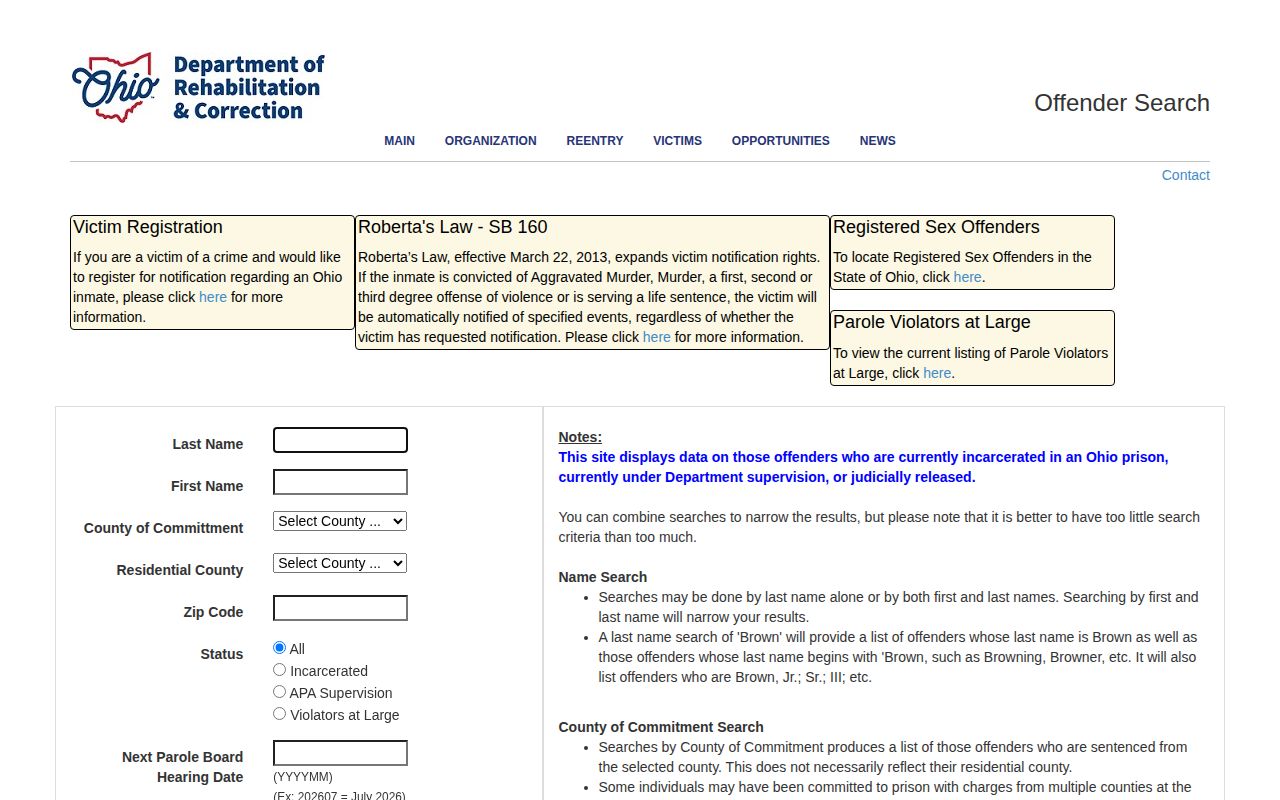
Those status choices show why a single Released-only query cannot resolve every Greene County supervision question.
Note: A state supervision record confirms release from prison, but it does not prove that every part of the sentence has ended.
Greene County Probation Office
Greene County Adult Probation handles Common Pleas community control. It is not an archive of jail releases and should not be asked to supply a full protected supervision file. The public docket establishes the court order. Office contact can then help route a lawful question about a local case.
Greene County Adult Probation
45 North Detroit Street, third floor
Xenia, OH 45385
937-562-5266
Monday through Friday, 7:30 a.m. to 4 p.m.
The ODRC search detail should identify the correct APA office for a state case. A regional reentry coordinator is not necessarily the assigned parole officer or reporting location. Verify the office in the person detail or through APA before travel.
Municipal supervision requires the same care. Xenia and Fairborn Municipal Courts handle misdemeanor matters within their jurisdictions, so a Common Pleas search alone may miss the controlling order. Match the court named on the charge or judgment, then ask that court’s probation channel about the public case route. Greene County Adult Probation should not be treated as the universal office for every person released from the county jail.
A direct office call can help route a question, but oral information is not the same as a signed order. Preserve the case number and request the court entry when the start, modification, or end of supervision needs documentary support.
Greene County Parole Hearings
The Ohio Parole Board is the state decision-making body. ODRC provides a month-level public schedule through the offender search field labeled Next Parole Board Hearing Date, entered in YYYYMM form. No separate verified day-by-day public calendar was found. Search the month, add a reliable identifier when known, then open the person detail for the next hearing or review and the latest stated result.
Ohio Administrative Code 5120:1-1-10 addresses initial hearings and later projected release dates or hearings after a denial. Rule 5120:1-1-11 requires a hearing before parole release, official minutes, and written notice following a denial. The exact record may say granted, denied, continued, deferred, retained, or rescinded. Do not replace that wording with a guess.
Parole eligibility depends on the sentence and controlling part of ORC 2967.13. A date eligible for board review is not an actual release date. When the legal basis matters, request the identifiable minutes or decision from ODRC after checking the public detail.
Greene County Supervision Terms
Conditions are the rules attached to release or a community sentence. They can include reporting, conduct, travel, or program duties stated by the lawful authority. A violation is an allegation that a term was broken. It does not erase the earlier release. A court or the state authority determines the response, which may range from continued supervision to a warrant, sanction, or return to custody.
Public access has limits. ORC 149.43 excludes probation and parole proceeding records from the ordinary public-record definition. That does not make every final state order or board minute secret. It means a request should target a public offender detail, signed court entry, or identifiable final order rather than demanding the full supervision file.
If an apparent release date conflicts with an ODRC status, build a custody timeline. Check the release detail, the latest hearing result, later court entries, and any new county booking. One valid release can be followed by a later arrest or violation.
Note: VINELink reports covered custody changes, but it is not the source for a full probation or parole case history.
Greene Leaf After Release
Greene Leaf is a distinctive local court and reentry path. The county describes it as a residential drug and alcohol program administered through Adult Probation for people sentenced through Common Pleas and both municipal courts. Its stated program length is 180 days, and the county says it has diverted felons from Ohio prisons since 2002.
A Greene Leaf placement should not be labeled parole merely because it follows jail or a court case. Read the actual sentencing or placement order. The county page also retains a former-jail address for a program unit, so telephone confirmation should precede a visit. This is especially important after the county consolidated adult jail operations at Greene Way.
Program participation does not supply the precise physical jail-release time. For that event, use the sheriff release sheet or movement record. The court docket explains the authority and placement terms.
Greene County Absconder Checks
ODRC’s Violators at Large list concerns alleged absconders from APA supervision. A listed residential address is last recorded data, not a statement of current whereabouts. Do not approach or try to detain a person. ODRC directs warrant information through law-enforcement systems and lists its Fugitive Section at 614-728-1938 and Fugitive.Val@odrc.state.oh.us.
The Greene County Sheriff Most Wanted page is a separate local clue. It may show selected bond- or probation-violation warrants, but it is not a complete warrant database and does not replace ODRC VAL for state supervision. A missing name does not clear a warrant. Law enforcement must verify current warrant status.
The official ODRC VAL image below comes from the state Violators at Large search.
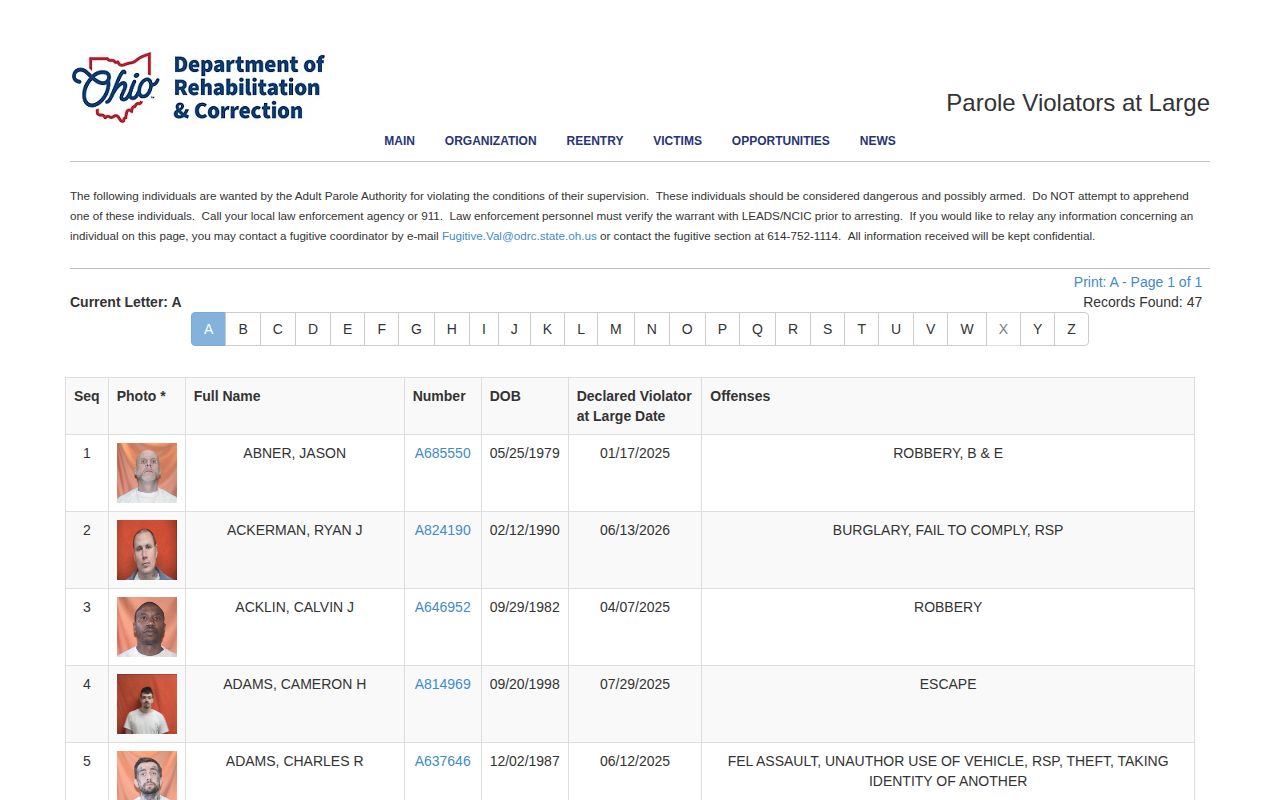
It illustrates the state absconder channel that must be kept distinct from Greene County’s selected local warrant page.
Greene County Supervision Discharge
Supervision ends through a formal discharge, termination, expiration, or other order recognized by the responsible authority. Leaving a jail or prison is not enough. For ODRC, inspect current status and parole or release detail. For county community control, review the Common Pleas docket for a signed termination or discharge entry. A later sealing action affects public access but should not be substituted for proof that supervision ended.
When public sources disagree, preserve each agency’s exact wording and date. A sheriff release sheet proves the county custody departure. A court order explains probation and its end. ODRC controls state supervision status. Those records can all be accurate because they describe different stages.
A discharge question should be narrow. Ask for the public final order or identifiable docket entry. Do not request protected treatment reports, violation investigations, or risk material. If no image appears online, use the case number and entry date to request the signed document from the correct clerk or ODRC records office.