
Greene County Release Date Types
A projected date is a calculation or eligibility marker based on the current sentence record. An actual release date records a completed custody event. Those facts can diverge. A future date may move because of credit, conduct, another sentence, a hold, court action, or the statutory process for an indefinite term. A past expected date also does not prove release if the current status still says incarcerated or supervised.
Greene County’s public jail cards do not show an equivalent projected-date field. A pretrial detainee has no sentence end to calculate. Bond may be set or a court may order release, but physical departure still depends on processing and other holds. For a local sentence, the signed judgment, jail-time credit, and jail record form the calculation trail.
- Projected release date
- An agency calculation based on the sentence and facts then known.
- Parole eligibility
- The point at which a sentence may become eligible for board review, not a release promise.
- Jail-time credit
- Qualifying confinement credited toward a prison term.
- Detainer
- A hold from another authority that may affect where a person goes next.
Find Greene County Release Dates
First identify the last custodian. A Greene County Jail departure, an ODRC prison release, and a federal release use different records. Do not treat absence from the current county roster as proof that a date arrived. A county-to-ODRC transfer merely changes custodians.
- Locate the sentencing case and read the signed judgment. Note the term, jail-time credit, and whether terms run together or one after another.
- For an ODRC sentence, open the ODRC Offender Search. Search all statuses by offender number or name before narrowing.
- Use Greene as County of Commitment when helpful, but repeat without that filter for multi-county cases. Match the docket, offense, admission, and former institution.
- Read Expected Release Date/Parole Eligibility Date, current status, and any Parole or Release Detail together.
- For a county sentence, contact Greene County Jail Records and the sentencing clerk for the current calculation and eventual release sheet.
The Greene County released-inmate record path explains how to confirm the completed event. It should not be replaced by an unofficial arithmetic estimate.
The official ODRC search screen includes status, county, and hearing filters relevant to a Greene County release date lookup.
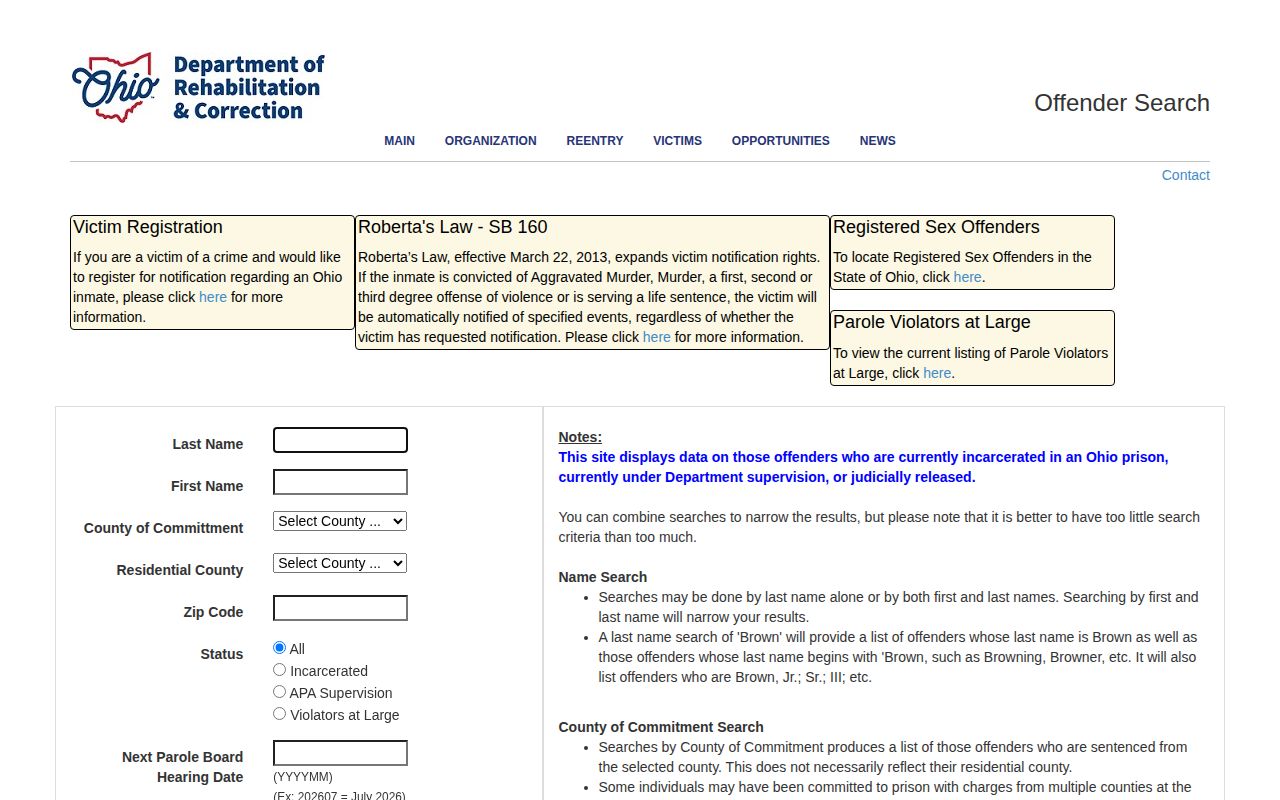
Begin broadly because a Released-only filter may hide a person on APA supervision or in another state status family.
Greene County Sentence Inputs
An ODRC date starts with the sentencing entry and stated prison term. Consecutive terms run one after another, while concurrent terms run at the same time, subject to the judgment and governing law. Jail-time credit under ORC 2967.191 accounts for qualifying prior confinement. Mandatory portions, life terms, offense-specific eligibility, indefinite sentencing, and later court orders can change which date matters.
County jail sentences must remain with the Greene County jail and sentencing court. Research found no Greene-specific public good-time or weekend-release policy. ODRC’s state-prison credit rules cannot simply be imported into a local jail term, and a weekend date should not be moved to Friday without an official rule or agency confirmation.
For an unresolved pretrial case, there may be no projected release date at all. The court can change bond or enter a release order, but another warrant or agency hold may delay physical departure. The jail release sheet reconciles legal authority with the actual custody end.
A local calculation also needs the correct case set. One person may have a felony in Common Pleas and a misdemeanor in Xenia or Fairborn Municipal Court. An order in one case does not cancel a hold in another. Review each docket for bond, sentence, jail credit, and later warrants, then ask the jail whether another authority still controls the person’s movement.
Transfers deserve their own label. When Greene sends a sentenced felon to ODRC, the county roster can lose the name even though confinement continues. ORC 2949.12 generally governs conveyance to the state reception facility. After transport, ODRC becomes the source for the prison projection and eventual state release.
Note: A court order can permit release before jail staff complete identity, bond, paperwork, and hold checks.
Ohio Earned Release Credit
For qualifying confinement beginning April 4, 2024, ORC 2967.194 permits eligible people to provisionally earn one or five days for each completed month of productive participation, depending on the statutory category. Completion of a second qualifying program or activity can add up to five days. Certain listed completions can produce 90 days or 10 percent of the stated term, whichever is less, for each qualifying completion, subject to the law.
The ordinary participation and completion credits under the stated cap cannot exceed 15 percent of an eligible stated term. Division (A)(3) completion credits receive separate treatment. Credits can be denied or withdrawn for rule violations. Exclusions include specified mandatory or nonreducible terms, death and listed murder or life sentences, and specified sexually oriented sentences. Former ORC 2967.193 applies to qualifying time before the new law’s start and should not be quoted as the current program.
Ohio has no universal rule that every prisoner serves exactly 85 percent. That figure is only the arithmetic remainder of the ordinary cap in a limited eligible setting. Jail credit, special completion credit, excluded sentences, judicial release, parole-eligible terms, and indefinite-sentence law defeat the shortcut.
The successful manifest capture comes from the current Ohio earned-credit statute.
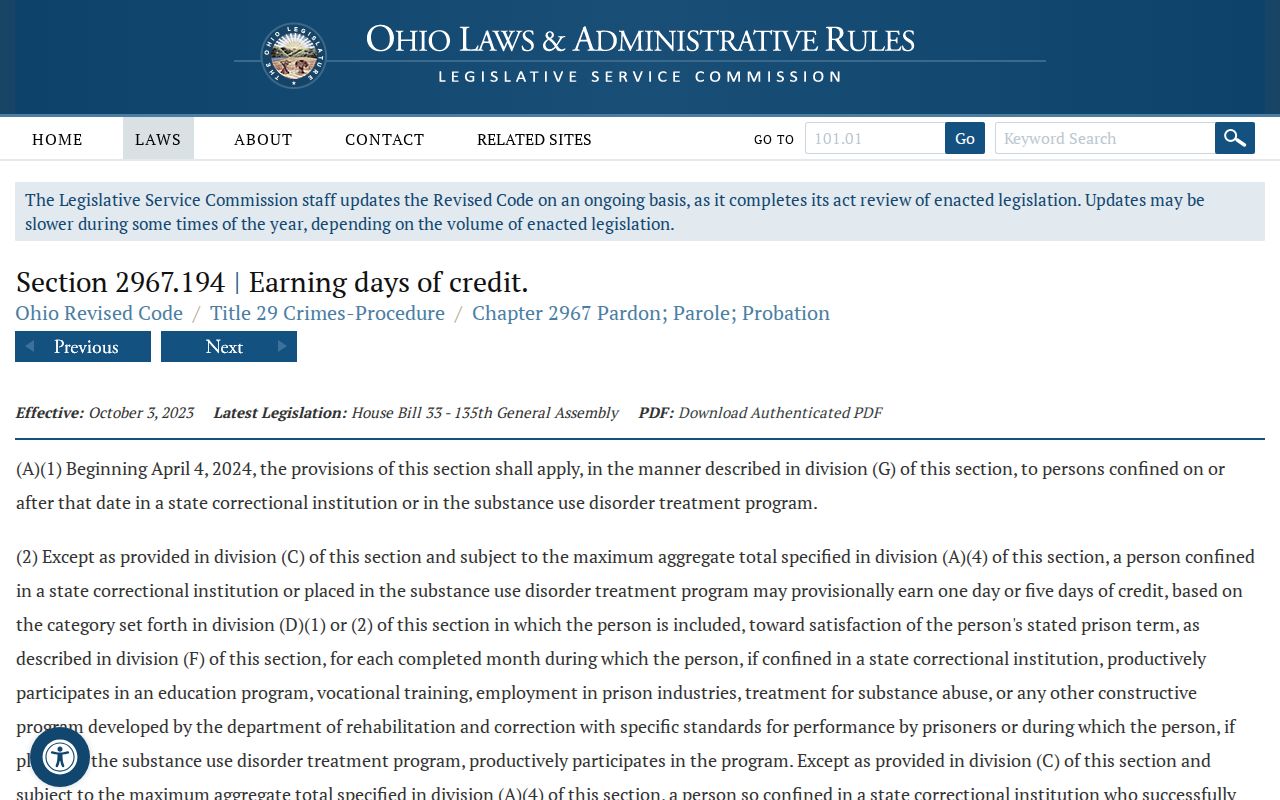
The statute’s categories and exclusions show why a flat percentage cannot produce a sound personal release forecast.
Greene County Date Changes
A date can change for reasons that arise after sentencing or are not clear from a simple result list. ODRC can recalculate credits, apply sanctions, process a new court order, or update a parole event. Another custodian may lodge a hold. Each factor has a different source, so the current detail and signed records matter more than an old screenshot.
| Factor | Possible effect | Best source |
|---|---|---|
| Jail-time credit | Credits qualifying prior confinement | Sentencing entry and ODRC sentence detail |
| Earned credit or loss | May reduce an eligible term or restore time after sanction | ODRC calculation and ORC 2967.194 |
| Detainer or another sentence | May change destination or prevent community release | Movement record and receiving agency |
| Parole Board action | May grant, deny, continue, retain, or rescind an event | ODRC detail and minutes |
| Court order | May alter a sentence or authorize judicial release | Signed court entry |
| Indefinite-term process | May retain a person past a minimum within limits | ODRC and ORC 2967.271 |
Under ORC 2967.271, qualifying non-life indefinite terms carry a presumption of release at the minimum or applicable presumptive earned-early-release date. ODRC may rebut that presumption through statutory process and retain the person no later than the maximum term.
Judicial release is another separate path. A court can order an eligible state prisoner released under the governing law and judgment, after which ODRC may show a released status and supervision detail. The court entry supplies the authority, while the ODRC record confirms the state custody change. Neither should be reduced to a guessed credit percentage.
Greene County Parole Dates
ODRC’s combined label may be a projected release date or a date pending parole consideration. Parole eligibility means the Board can consider release under the sentence. It is not an order that release must occur. The verified schedule path is the offender-search month field for the next hearing, not a separate day-by-day calendar.
OAC 5120:1-1-10 addresses initial hearings and later projected release dates or hearings following denial. The Board may accelerate, retain, or rescind a projected date through the stated process. OAC 5120:1-1-11 addresses hearings, minutes, and written denial notice.
Read the exact outcome. Granted, denied, continued, deferred, retained, and rescinded have different meanings. If public detail is not enough, request the identifiable minutes. Do not calculate parole from a generic minimum because ORC 2967.13 makes eligibility sentence-specific.
Reconcile Greene County Release Dates
If an ODRC expected date has passed, do not announce an error. Check current status, Parole or Release Detail, the next hearing or result, and all sentence cases. The field may have been parole eligibility rather than mandatory release. Board action, a sanction, recalculation, an indefinite-term process, or another sentence can explain the gap.
A successful manifest image from an official ODRC released example shows the offender photograph beside the combined expected-release or parole-eligibility field.
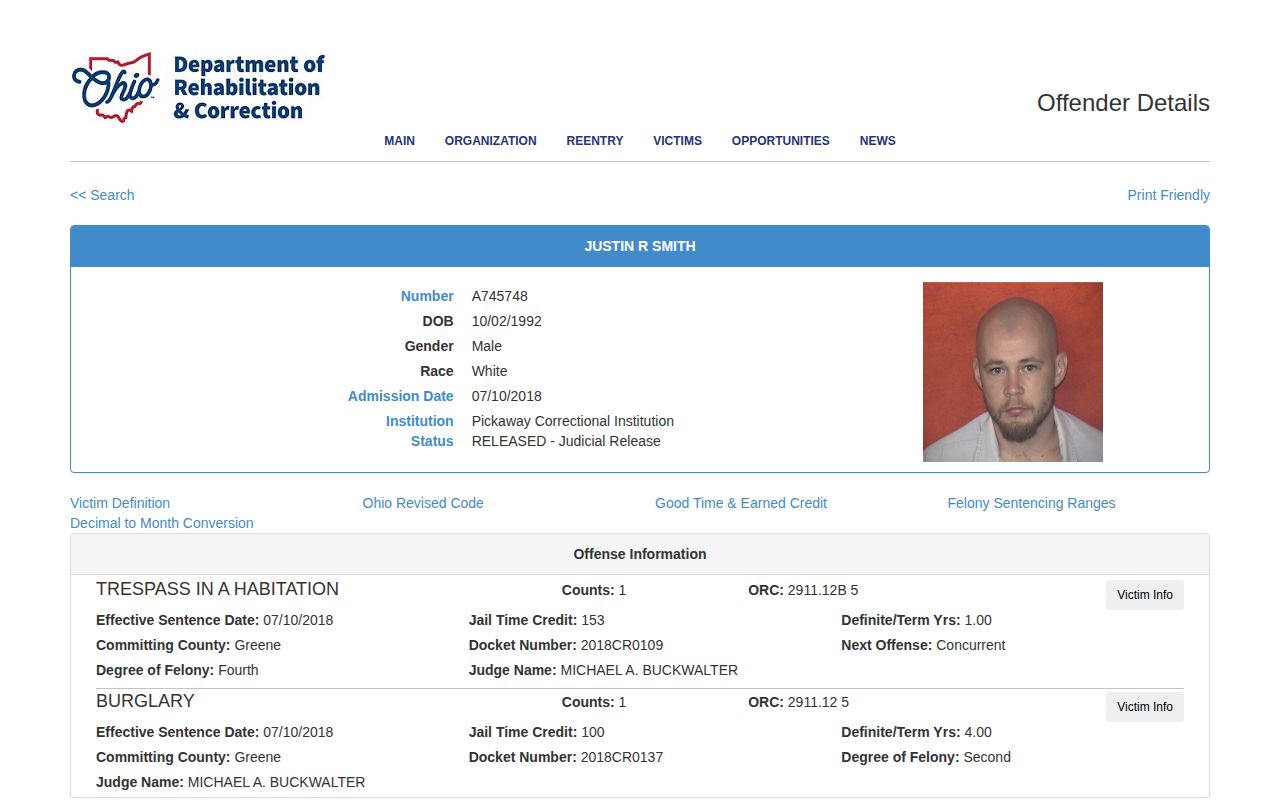
The example shows why current status and release detail must be read with the calendar field.
Greene County Jail provides no matching public projected field. For a county sentence, request the sentence entry, jail-time credit, consecutive or concurrent structure, and actual release sheet. If the person was transferred to ODRC, roster removal marks a change in custodian, not community release.
Confirm Greene County Release
A pending event can be monitored through a person-specific Greene County VINE inmate check. Register while the person is in covered custody, then verify any notice. VINE does not establish the legal basis, exact physical departure time, or receiving custodian.
For county custody, Jail Records can confirm the operational event, and a Corrections request can seek the release sheet and movement history. For state custody, ODRC current status and Parole or Release Detail are the main public path. The court docket supplies sentence or judicial-release authority. Federal and immigration dates remain with BOP and ICE.
Keep a timeline when systems appear to conflict. A person can leave Greene County Jail, enter ODRC, later leave prison under APA supervision, and later discharge. Each date answers a different question. Preserve agency, exact label, access time, and matching identifier without retaining needless personal details.
County court records add the legal sequence. Common Pleas handles felony matters, while Xenia and Fairborn Municipal Courts handle misdemeanors within their jurisdictions. A docket may show bond, dismissal, sentence, jail credit, judicial release, or a later violation. The signed judgment controls its terms. The sheriff record still supplies the physical county departure, which can occur after the court’s order because staff must resolve other holds and processing.
For an older state date, preserve the offender number and case rather than relying on the photograph. ODRC Central Records at P.O. Box 430, Columbus, OH 43216 is the records path when public detail does not resolve an identifiable release or parole field. Protected inmate and supervision material remains subject to Ohio access limits, so request the existing public detail or final order with care.
Note: An actual release date ends one custody interval; it does not prove that the court case or all supervision ended.